Today: your morning list
What is owed this morning, grouped by where it came from, in the order it has to happen.
Today is the desk's morning: everything waiting on you, worked out from what is actually on file — interviews, submissions, chases, messages waiting to be read, links nobody answered. Nothing on it is guessed.
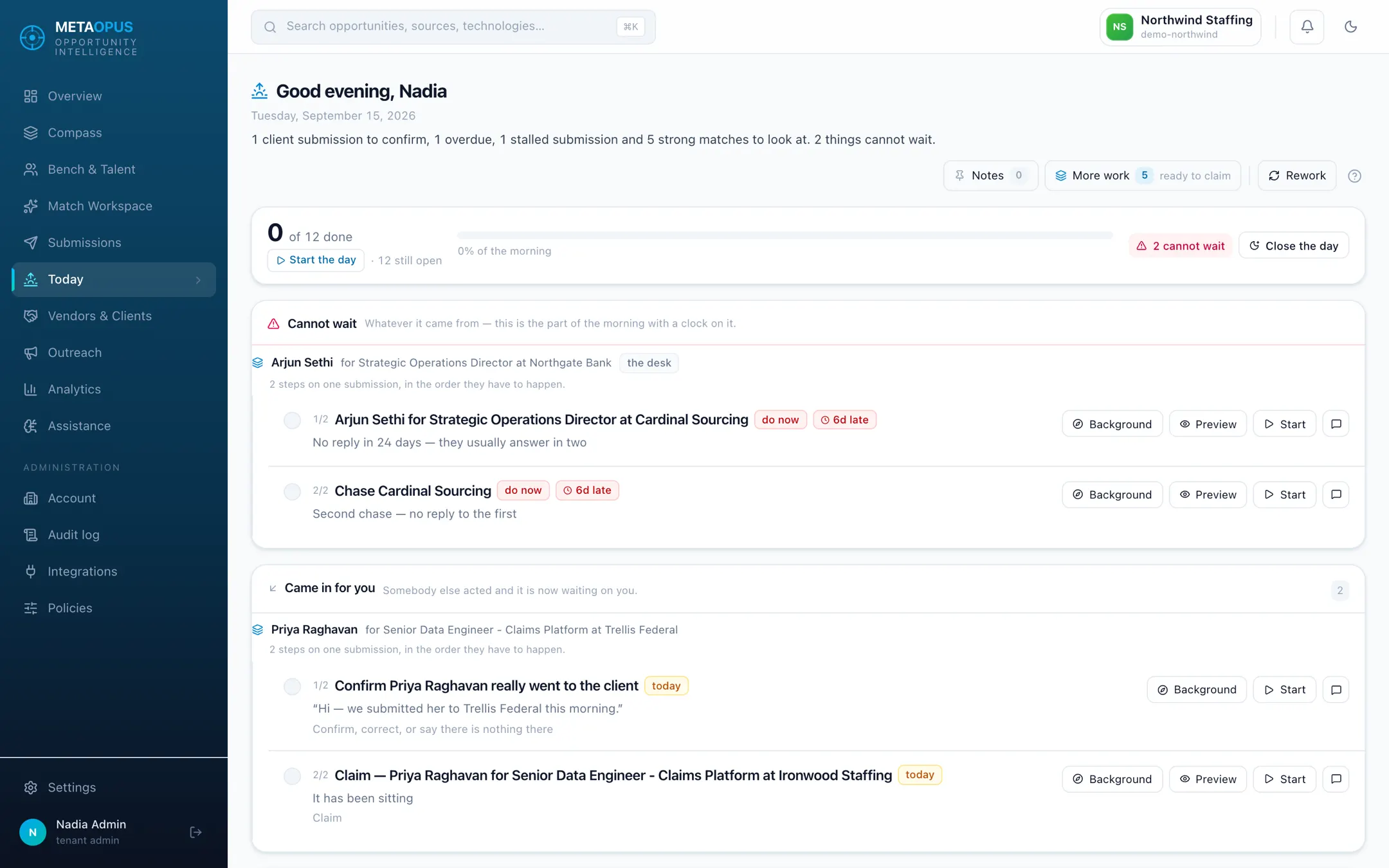
Why it is grouped by where it came from
Something you claimed is a commitment. Something the matching found is a suggestion nobody has taken. A flat list makes those look identical, and they are not.
Why this order
Time beats everything once something has a time on it. After that, work you cannot recover from — an interview, a client submission signal, a consultant waiting on you — outranks work that simply slips a day.
Nothing is assigned to you
The product surfaces work; a person takes it. “Nobody is on these yet” means exactly that: claim one and it moves into your own section, and onto tomorrow's list if you have not finished it.
Start, rather than tick
Start says you are on it and takes you to the record. The row stays on your list marked so nobody picks it up twice and you can see where you left off.
Ticking a row records that you dealt with the line — it does not send a submission or release a claim. If the work is still live tomorrow the row comes back, marked as ticked and still here, so nothing disappears by being ticked.
Four rows about one submission
They are one job shown four times, so they are grouped in the order they have to happen. Nothing is ever recommended before the thing it depends on.
Frequently asked
Why does an interview never fall off the bottom?
Some things can never be ranked away. If the list is full and an interview would have dropped off, it comes back pinned — a plan that can bury an interview is worse than no plan.
What happens when I pass on something?
It asks why. A category you skip every morning is either work the list should stop suggesting or work the desk has quietly stopped doing, and both are worth knowing.
Can I hand a row to a colleague?
Yes. It goes onto their list under “came in for you”, with your question as the reason and your deadline as the due date, and their answer comes back to you.
Was this helpful?
More in Submissions
- The submission stages Ready, Sent, Progressing and Closed — what each means and what moves between them.
- Next action, waiting on, and what is late Where the next step comes from, who is holding a submission, and what turns red.
- Chasing what is owed One sitting that clears a morning of follow-ups, grouped by who you are chasing.
- Likelihood and health scores What thin, fair and strong mean, and why every score opens its reasons.
- Building a submission Consultant first, then the route, then the rate — and what the vendor actually receives.
- Interviews, offers and starts Why an acceptance is tied to one version, and why a start is a separate act.
Still stuck? Tell us what you are trying to do — a person answers, and we would rather fix the product than explain it twice.