Account details, billing and your team
What an invoice needs, which documents are held, and how people are added.
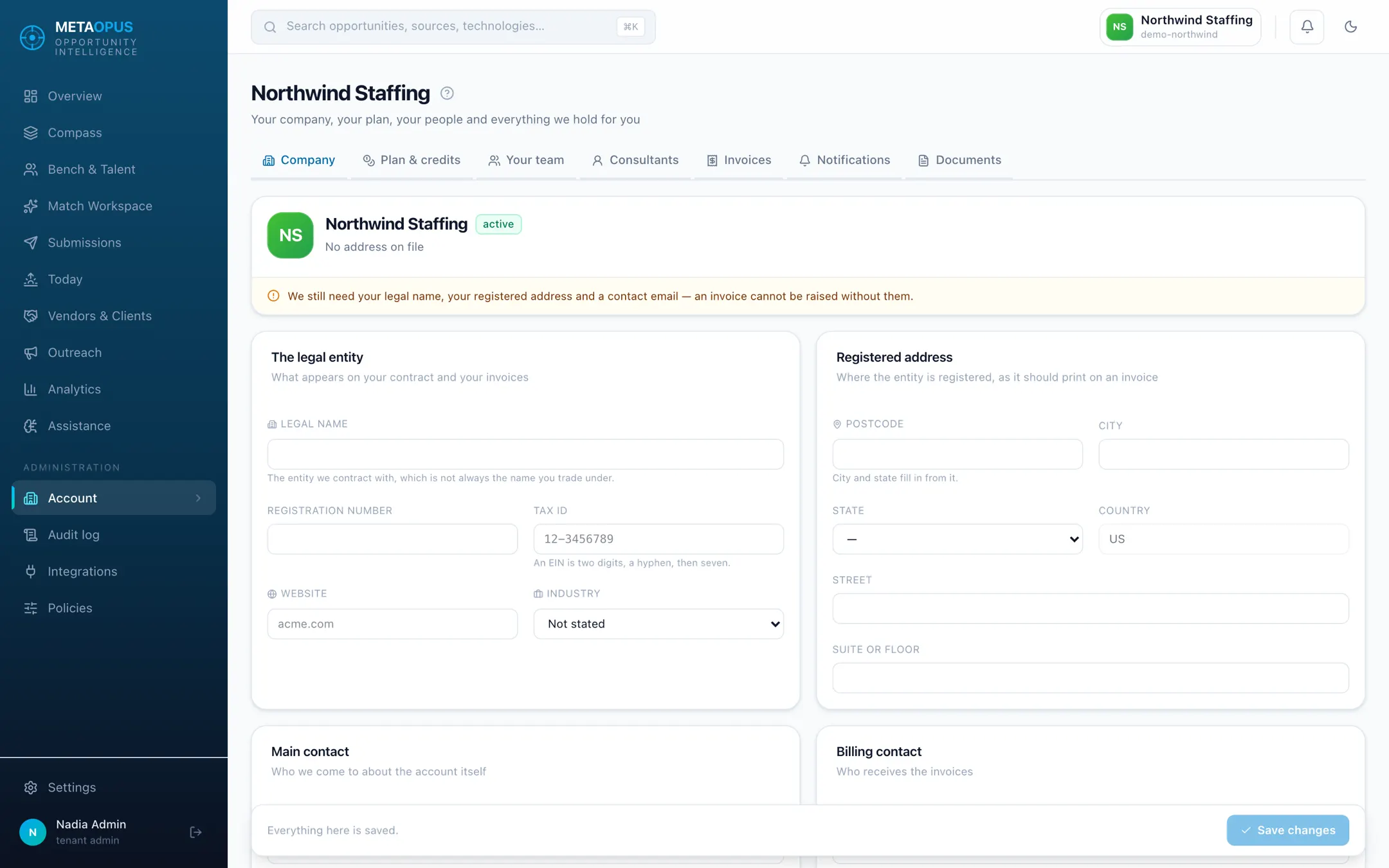
Open your account in MetaOpus- Legal name and address — what goes on your invoices. An invoice cannot be raised without them, which is why they are asked for first.
- Billing contact — where invoices go. Left empty, they go to your main contact.
- Documents — the agreements and tax forms we are required to hold. Which ones depends on where you are registered.
- Expiry — an insurance certificate lapses, so you are asked again before it does rather than after.
Your team
Everybody with a sign-in is listed under your account, and each role says exactly what it allows before you grant it. Adding somebody does not give them the whole desk; it gives them the role you chose.
Frequently asked
Why is a legal name required before anything else?
Because an invoice cannot be raised without it. It is asked for first so the request never arrives at the worst possible moment, which is the day you want to be billed.
Does adding somebody give them the whole desk?
No. They get the role you chose, and each role says exactly what it allows before you grant it.
Why do you hold documents at all?
Because agreements and tax forms are required to invoice and to work together. Which ones depends on where you are registered, and an expiring one is asked for before it lapses rather than after.
Was this helpful?
More in Account & security
- Roles, sign-in security and the audit log Who can see what, how sign-ins are protected, and what is recorded.
- Why a setting is what it is Every level that was consulted, what is never a setting, and the changes that need two people.
- Where the work comes from Sources, what each is contributing, and why a healthy one can sit at zero.
- Mail, storage and model connections What healthy actually means, and why a test sends a real message.
- Connect Claude, ChatGPT and other AI assistants Connect an AI assistant to MetaOpus, what it can look up for you, and what it never sees.
Still stuck? Tell us what you are trying to do — a person answers, and we would rather fix the product than explain it twice.